

Starch microspheres have become a significant research focus across pharmaceutical, food, and cosmetic industries, valued for their biocompatibility, biodegradability, non-toxicity, and relatively low production cost. Products such as Spherex™, Arista™, and EmboCept™ have already demonstrated their commercial viability as drug delivery vehicles, haemostatic agents, and embolization agents. As demand grows, so does the need for scalable and cost-efficient production methods. A 2018 study published in LWT – Food Science and Technology by Li et al. addresses this challenge directly, presenting a water-in-water (W/W) emulsion method for producing recrystallized starch microspheres (RSMs) combined with a practical strategy for recycling the polyethylene glycol (PEG) continuous phase.
Why the Water-in-Water Emulsion Method?
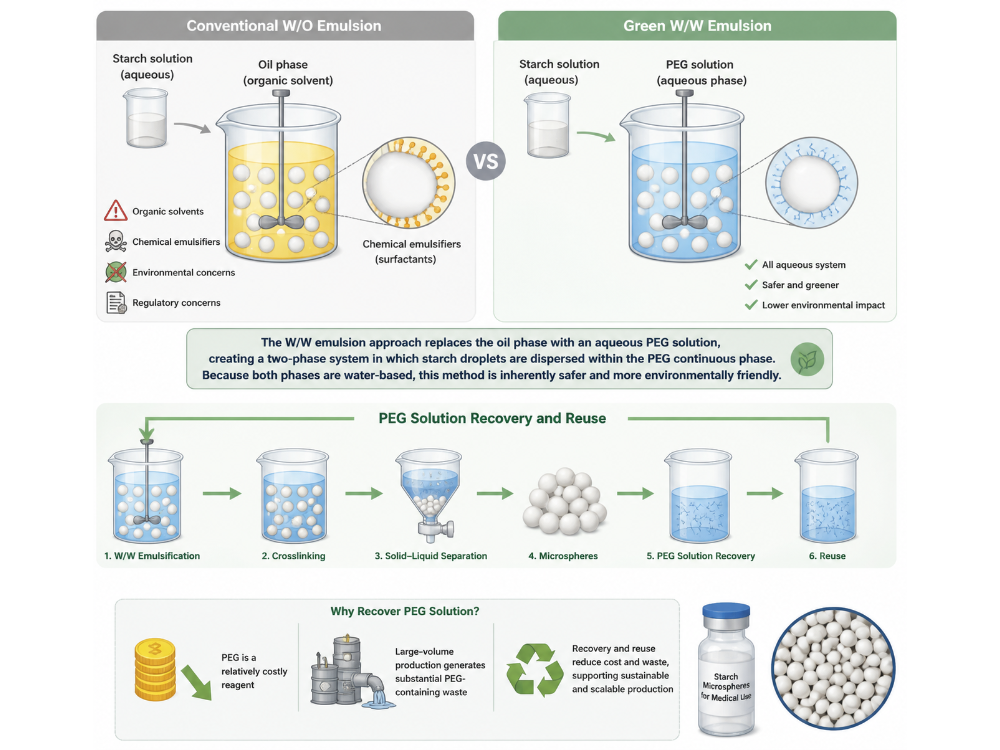
Conventional emulsion methods for microsphere production typically rely on water-in-oil (W/O) systems, which involve organic solvents and chemical emulsifiers that raise safety, environmental, and regulatory concerns. The W/W emulsion approach replaces the oil phase with an aqueous PEG solution, creating a two-phase system in which starch droplets are dispersed within the PEG continuous phase. Because both phases are water-based, this method is inherently safer and more environmentally friendly. However, PEG is a relatively costly reagent, and large-volume production would generate substantial amounts of PEG-containing waste if the solution were discarded after each batch. The researchers therefore investigated whether and how the PEG solution could be effectively recovered and reused.
Two Recycling Strategies: DR-PEG vs. RS-PEG
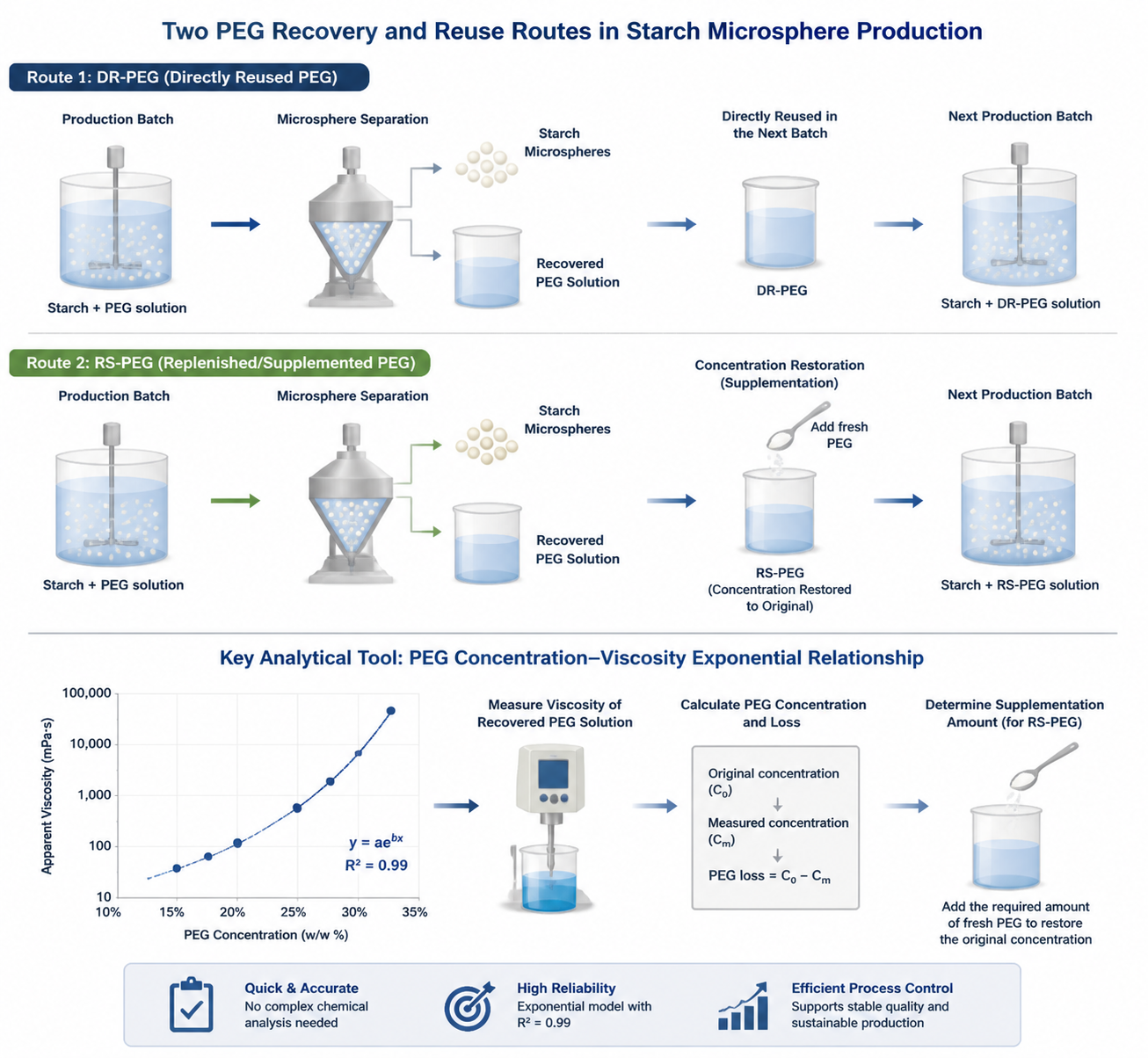
The team tested two recovery routes. In the first, the PEG solution collected after microsphere separation was used directly in the next production batch without any modification — referred to as DR-PEG (directly reused PEG). In the second route, the recovered PEG solution was supplemented with fresh solid PEG to restore the original concentration before reuse — referred to as RS-PEG (replenished/supplemented PEG).
A key analytical tool was the exponential relationship between PEG concentration and apparent viscosity, which the researchers established with an R² value of 0.99. By measuring the viscosity of the recovered solution, they could quickly and accurately calculate how much PEG had been lost and how much supplementation was required, without the need for complex chemical analysis.
Results: RS-PEG Outperforms Direct Reuse
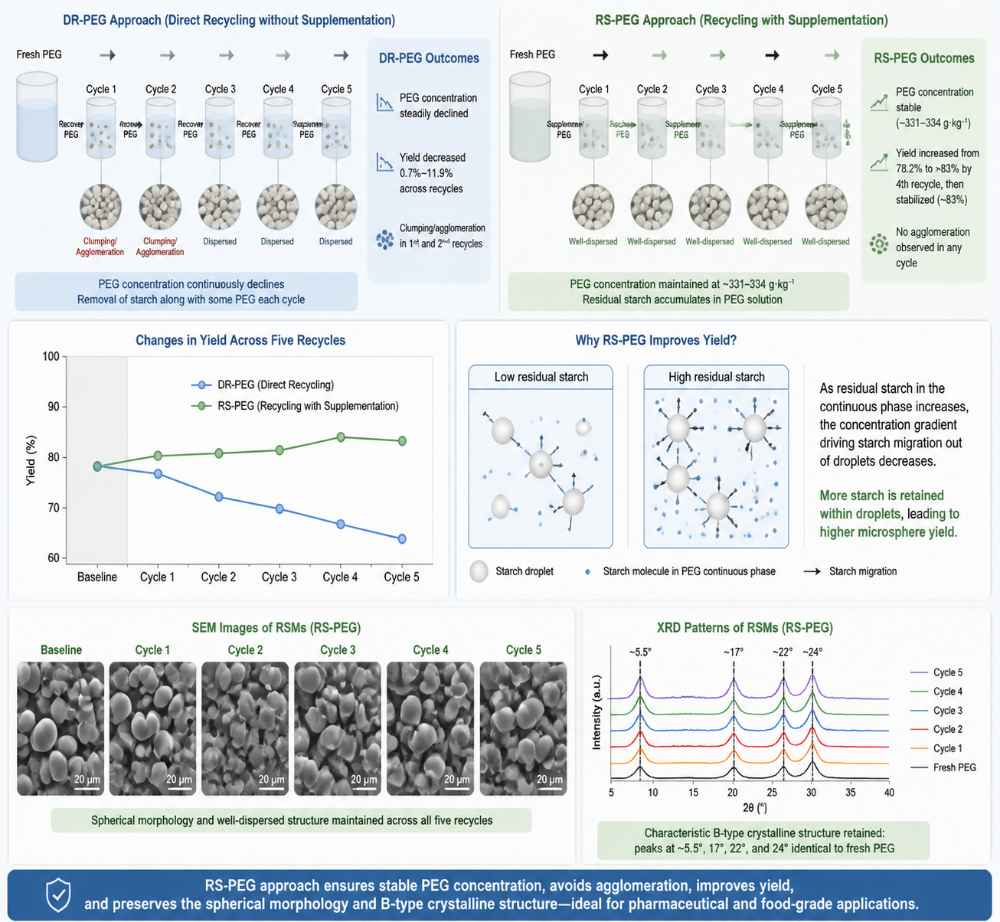
The DR-PEG approach proved problematic. Because each cycle removed starch along with some PEG, the PEG concentration in the recovered solution steadily declined. This caused the yield of RSMs to fall by 0.7%–11.9% across successive recycles. More significantly, clumping and agglomeration of microspheres were observed in the first and second recycle batches — an outcome that would be unacceptable in pharmaceutical or food-grade applications.
The RS-PEG approach delivered considerably better results. By maintaining a consistent PEG concentration (approximately 331–334 g·kg⁻¹) through targeted supplementation, the method not only avoided agglomeration across all five tested cycles but actually increased yield from 78.2% in the baseline batch to above 83% by the fourth recycle, stabilizing at around 83% thereafter. The improvement is attributed to the progressive accumulation of starch molecules in the recycled PEG solution. As residual starch in the continuous phase increases, the concentration gradient driving starch migration out of the dispersed droplets decreases, meaning more starch is retained within the droplets and ultimately converted into microspheres.
Scanning electron microscopy (SEM) confirmed that RSMs produced using RS-PEG solution retained their spherical morphology and well-dispersed nature across all five recycles. X-ray diffraction (XRD) analysis further showed that the characteristic B-type crystalline structure — with diffraction peaks at approximately 5.5°, 17°, 22°, and 24° — remained identical to that of microspheres produced with fresh PEG, confirming that recycling had no adverse effect on crystalline quality.
Practical Implications
This study establishes that PEG can be recycled multiple times in the W/W emulsion production of RSMs without compromising product quality, provided that concentration is monitored and restored between cycles. The viscosity-based concentration estimation method offers a straightforward, low-cost analytical approach suitable for practical manufacturing settings. The findings contribute meaningfully to reducing both the material cost and the environmental footprint of RSM production. The authors note, however, that drug loading capacity and controlled release performance of RSMs produced via the RS-PEG method remain to be characterized — an important area for future investigation before these microspheres can be fully evaluated for specific pharmaceutical applications.